(Why the Future of Wellness May Depend on Bridging Both Worlds)
There has long been a cultural tendency to separate wellness into opposing categories.
Science versus spirituality.
Data versus intuition.
Evidence versus tradition.
One side is often positioned as measurable and legitimate. The other as abstract, emotional, or anecdotal.
But history suggests the divide may not be as absolute as modern culture sometimes assumes.
Across civilizations, many practices now being explored through neuroscience, physiology, behavioral psychology, and longevity science were not originally born inside laboratories. They emerged through observation, ritual, lived experience, and centuries of refinement.
Meditation existed long before brain scans.
Breath regulation existed before nervous system terminology.
Yoga existed before biomechanics research.
Plant-based nutrition existed before nutritional epidemiology.
Sound, touch, stillness, community, and energetic practices have existed in nearly every ancient culture in some form for thousands of years.
Today, modern science is increasingly studying many of these same practices through measurable frameworks.
Not to replace ancient understanding. But to better understand why certain methods appear to influence human physiology, stress regulation, cognition, recovery, emotional resilience, and overall well-being.
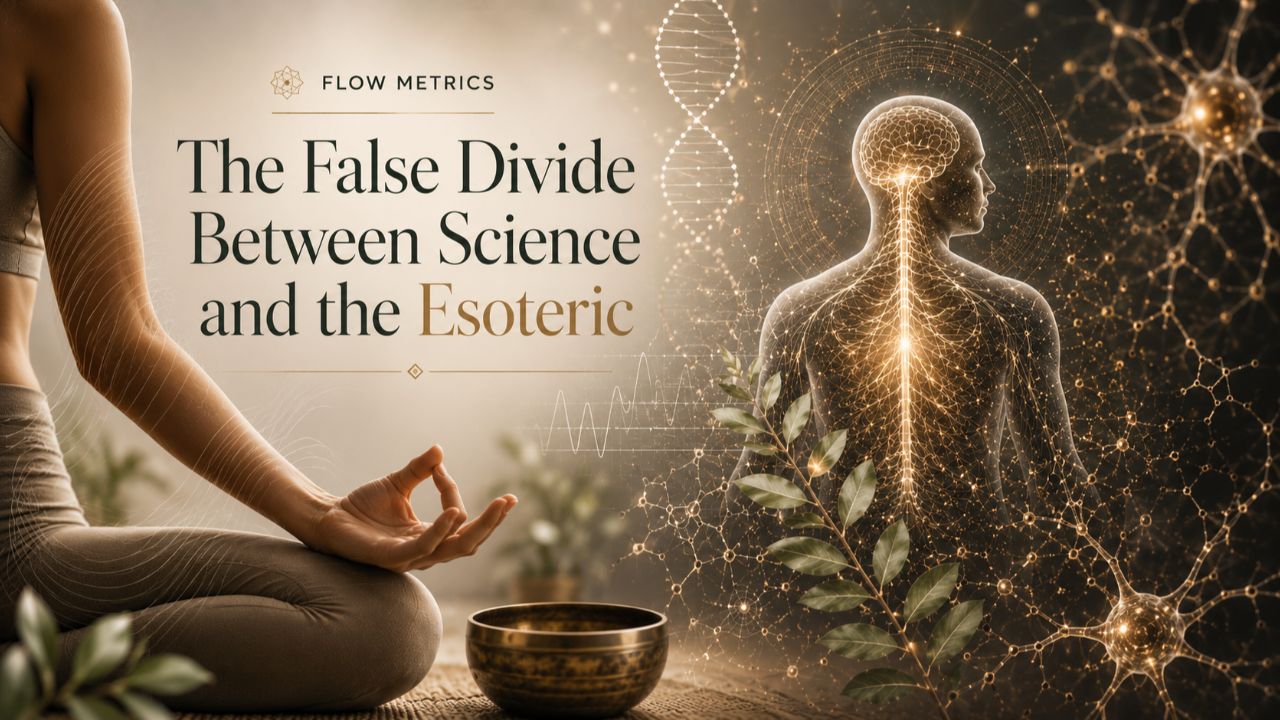
The conversation may not be science versus the esoteric.
It may simply be that science is gradually learning how to measure what humanity has long attempted to understand experientially.
The Problem With Hype
Innovation often moves faster than consumer understanding.
This is especially true within wellness, longevity, regenerative medicine, and bio-optimization culture.
As new technologies emerge, excitement tends to accelerate rapidly. Terms become popularized before consumers fully understand what they mean. Marketing expands faster than education. Social media compresses complex subjects into viral soundbites.
The result is an environment where people can struggle to distinguish between:
-
evidence-based innovation,
-
preliminary research,
-
exaggerated claims,
-
and pure marketing theater.
This is not unique to wellness.
Historically, nearly every rapidly growing industry experiences a phase where enthusiasm temporarily outpaces clarity.
But sustainable industries are not built on excitement alone.
Long-term credibility requires:
-
transparency,
-
ethical communication,
-
realistic expectations,
-
ongoing research,
-
and public education.
Consumers are becoming more informed. They are asking deeper questions. They are beginning to differentiate between aesthetics and substance.
And this shift matters.
Because trust is becoming one of the most valuable currencies in modern wellness.
Ancient Practices, Modern Data
The most interesting development in wellness may not be the emergence of entirely new ideas.
It may be the increasing ability to measure ancient ones.
Meditation, for example, has been associated with measurable changes in stress response, emotional regulation, attention, and even structural brain adaptations in long-term practitioners【1】【2】.
Yoga has been studied for its effects on flexibility, balance, cardiovascular health, nervous system regulation, inflammation, and mental health outcomes【3】【4】.
Breath-focused practices are increasingly examined through the lens of autonomic nervous system regulation and vagal tone【5】.
Nutritional patterns long emphasized in traditional cultures continue to be associated with metabolic health, inflammation reduction, and longevity outcomes【6】.
Even practices historically labeled “alternative” are beginning to enter research conversations with increasing seriousness.
This does not mean every claim is validated.
Nor does it mean every modern wellness trend deserves scientific legitimacy.
But it does suggest something important:
Human beings have spent thousands of years experimenting with ways to regulate the body, calm the mind, strengthen community, cultivate resilience, and create meaning.
Modern science now possesses tools capable of studying some of these effects more directly.
That is not opposition.
That is convergence.
The Wellness Industry’s Responsibility
As wellness grows commercially, responsibility grows with it.
Especially in spaces connected to longevity, regenerative wellness, energetic practices, and human optimization.
Because consumers are increasingly navigating:
-
conflicting information,
-
influencer-driven marketing,
-
emotionally persuasive narratives,
-
and scientific terminology used without context.
This creates an ethical responsibility for wellness professionals, educators, studios, clinics, and brands.
Education must become part of the experience.
Not fear-based skepticism.
Not blind belief.
But thoughtful interpretation.
There is a meaningful difference between:
-
curiosity and certainty,
-
possibility and proof,
-
emerging research and established consensus.
Ethical communication leaves room for nuance.
And nuance is often missing in modern digital culture.
Why Human Experience Still Matters
One of the limitations of purely reductionist thinking is the assumption that only what is fully measurable has value.
But human experience has always contained dimensions difficult to quantify completely.
Connection.
Presence.
Meaning.
Emotional resonance.
Stillness.
Belonging.
These experiences influence behavior, stress physiology, relationships, nervous system regulation, and long-term health outcomes in ways science continues attempting to map more clearly.
The placebo effect itself demonstrates the profound relationship between perception, expectation, belief, and physiological response【7】.
Importantly, acknowledging this does not require abandoning scientific rigor.
It simply requires intellectual humility.
Some phenomena may already be measurable. Others may not yet be fully understood. And some wellness practices may ultimately prove ineffective under scrutiny.
That is precisely why ethical research matters.
Science is not weakened by asking questions.
It is strengthened by it.
Building Healthy Foundations Early
Many wellness habits associated with resilience and long-term health are not inherently modern.
Movement.
Stillness.
Community rituals.
Mindful eating.
Breath awareness.
Restorative practices.
These have existed across cultures for generations.
Introducing people to these practices earlier in life may help normalize healthier relationships with stress, movement, emotional regulation, and self-awareness over time.
Not through fear. Not through perfectionism. But through exposure and consistency.
A child who learns to breathe through stress may carry that skill into adulthood.
A teenager introduced to mindful movement may develop a healthier relationship with their body.
Someone exposed early to reflective practices may navigate emotional intensity differently later in life.
These concepts are increasingly explored through behavioral science and developmental psychology, but many cultures historically embedded such practices naturally into daily life long before modern terminology existed.
Again, this is not a contradiction between science and tradition.
It is another example of overlap.
The Future May Belong to Integration
Wellness does not need to choose between evidence and experience.
The future may belong to the organizations, educators, and practitioners capable of integrating both responsibly.
Scientific literacy matters. Research matters. Ethics matter.
But so do ritual, embodiment, presence, and lived human experience.
The strongest wellness spaces of the future may not be the loudest. They may be the most transparent.
The ones willing to say:
-
this is established,
-
this is emerging,
-
this is experiential,
-
and this is still being studied.
Because trust is built when communication becomes clear.
And clarity matters more than hype.
Especially in industries shaping how people care for their bodies, nervous systems, longevity, and overall well-being.
Perhaps the true evolution of wellness is not about replacing ancient wisdom with science.
But allowing science and human experience to inform one another more intelligently.
References:
【1】Tang YY, Hölzel BK, Posner MI. The neuroscience of mindfulness meditation. Nature Reviews Neuroscience. 2015.
【2】Fox KC et al. Is meditation associated with altered brain structure? Neuroscience & Biobehavioral Reviews. 2014.
【3】Cramer H et al. Yoga for improving health-related quality of life, mental health and cancer-related symptoms in women diagnosed with breast cancer. Cochrane Database. 2017.
【4】Ross A, Thomas S. The health benefits of yoga and exercise: a review of comparison studies. Journal of Alternative and Complementary Medicine. 2010.
【5】Laborde S et al. Heart Rate Variability and Cardiac Vagal Tone in Psychophysiological Research. Frontiers in Psychology. 2017.
【6】Willett WC et al. Mediterranean diet pyramid: a cultural model for healthy eating. American Journal of Clinical Nutrition. 1995.
【7】Benedetti F. Placebo Effects. Oxford University Press. 2014.
Ready to move from inspiration into action? Book your first class at Yoga Club PR – and experience intentional living, mindful movement, and radiant wellness firsthand.
Join the Flow Metrics Community
Curated wellness insights, timeless rituals, and modern strategies – delivered thoughtfully to your inbox.
Your privacy is respected and protected – always handled with the same care we bring to every practice.