
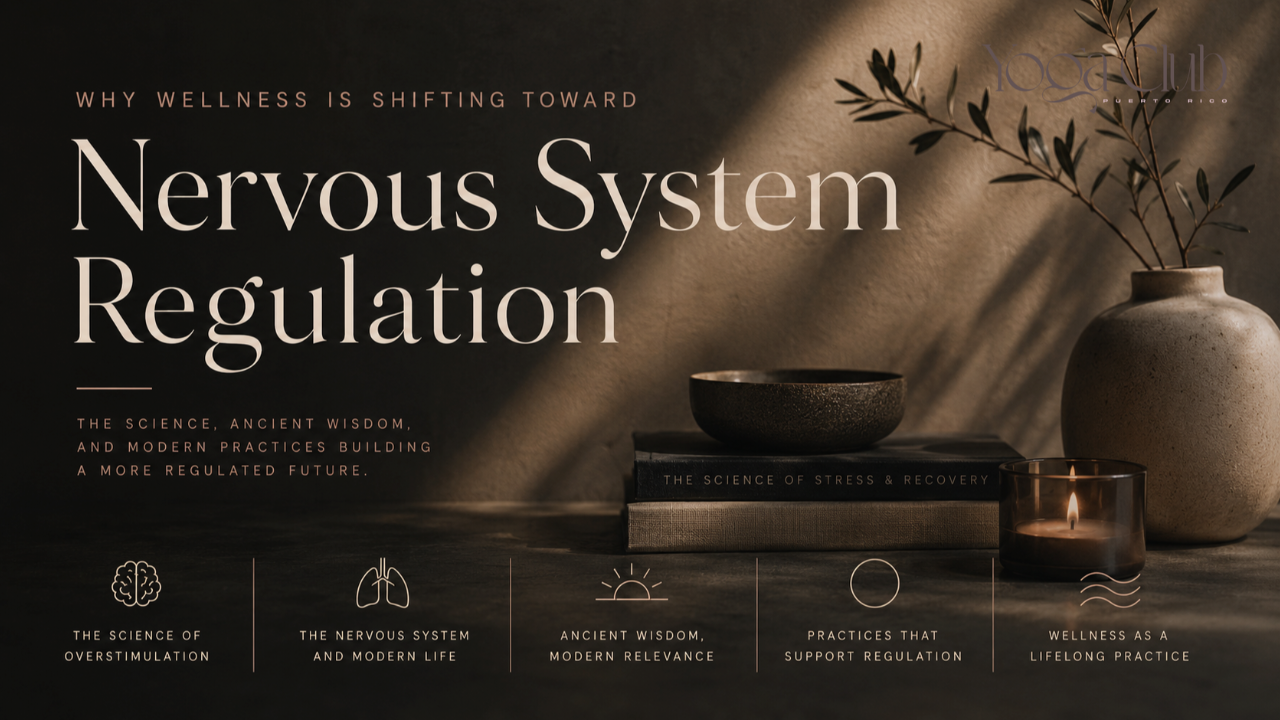
There was a time when wellness was marketed almost entirely through the lens of performance.
Stronger bodies.
Lower body fat percentages.
Higher productivity.
Earlier mornings.
Longer workouts.
More discipline.
For years, the dominant message suggested that health was something to conquer through optimization. The body became a project to refine. Recovery became another metric to track. Even rest itself was reframed as a productivity strategy rather than a biological necessity.
And while movement, nutrition, and discipline remain important components of health, something deeper has quietly begun shifting within modern wellness culture.
Increasingly, people are no longer searching solely for transformation in the mirror.
They are searching for relief in the nervous system.
Not because they have become weaker. Because they have become overwhelmed.
The modern human nervous system is processing an unprecedented level of stimulation. Continuous notifications. Financial uncertainty. Constant accessibility. Algorithm-driven media cycles engineered around urgency. Chronic digital exposure. Sleep disruption. Sedentary work paired with cognitive overload. Social comparison functioning at all hours of the day.
For many people, dysregulation has become so normalized that they no longer recognize it as dysregulation.
They simply call it life.
And consumers are responding accordingly.
According to McKinsey & Company’s Future of Wellness research, wellness has grown into a multi-trillion-dollar global industry increasingly driven by Millennials and Gen Z consumers who view wellness not as an occasional indulgence, but as a long-term investment in quality of life.【1】Importantly, these demographics are demonstrating growing interest in emotional wellness, mindfulness, sleep, stress management, recovery practices, and preventative health behaviors rather than appearance-based goals alone.【1】
That distinction matters.
Because true wellness has never been built on temporary motivation or trend participation. The individuals who remain committed to wellness for years often understand something far deeper than aesthetics. Wellness is not a short-term identity. It is a long-term relationship with the body, the mind, and the environments we repeatedly place ourselves inside.
The people most invested in wellness tend to study it.
Practice it.
Respect it.
Refine it over decades.
And increasingly, science is beginning to validate why these practices matter so profoundly.
The Physiology of Overstimulation
At the center of this conversation is the autonomic nervous system, the system responsible for regulating many of the body’s unconscious physiological processes including heart rate, respiration, digestion, stress responses, and recovery states.
Broadly speaking, the autonomic nervous system operates through two primary branches:
The sympathetic nervous system, associated with mobilization and stress activation, often referred to as “fight or flight.”
And the parasympathetic nervous system, associated with restoration, digestion, recovery, and physiological regulation, often referred to as “rest and digest.”
Both systems are necessary for survival. Problems emerge when chronic stress exposure prevents the body from adequately returning to regulation.
Research increasingly demonstrates that prolonged sympathetic activation is associated with elevated cortisol levels, impaired sleep quality, increased inflammation, emotional dysregulation, anxiety, cardiovascular strain, cognitive fatigue, and burnout-related symptoms.【2】【3】
In many ways, modern environments continuously condition the nervous system toward hypervigilance.
The body may sit still at a desk, yet physiologically remain in a low-grade survival response for hours at a time.
This is one reason why wellness itself is evolving.
Consumers are beginning to recognize that exhaustion is not merely emotional. It is physiological.
And they are seeking experiences capable of helping the body exit chronic activation states.
Ancient Systems Understood Regulation Long Before Modern Science Named It
Long before terms like vagal tone, autonomic regulation, or parasympathetic activation entered scientific literature, many ancient cultures had already developed practices centered around rhythm, breath, stillness, sensory awareness, and nervous system balance.
Not because they possessed modern neuroscience.
Because they possessed observation.
Traditional yogic systems in India emphasized pranayama, meditation, intentional movement, and breath regulation thousands of years before contemporary medicine began studying how respiratory practices influence autonomic function and emotional regulation.【4】
Traditional Chinese Medicine similarly approached health through the lens of energetic balance, nervous system harmony, respiration, circulation, and environmental rhythm. Practices such as qigong and tai chi emphasized controlled movement, breath synchronization, grounding, and internal awareness centuries before Western medicine developed formal language around stress physiology.【5】
Many contemplative traditions across Asia, Africa, Indigenous cultures, and monastic systems also recognized the relationship between stillness, ritual, breathing patterns, communal regulation, sound, and mental clarity long before these experiences were examined through neuroimaging or psychophysiological research.
Importantly, these systems did not separate mental, emotional, physical, and spiritual well-being into isolated categories the way modern industrialized culture often has.
Health was viewed more holistically.
The body was not simply mechanical.
It was relational.
Responsive.
Rhythmic.
Modern science is not “discovering” regulation as much as it is increasingly measuring mechanisms that many ancient systems already understood experientially.
Research on yoga, meditation, and breath-based practices now demonstrates associations with improved autonomic regulation, reduced sympathetic dominance, enhanced parasympathetic activity, reduced inflammatory markers, and improved emotional regulation outcomes.【6】【7】
Additional research has explored how yoga practices may influence gamma-aminobutyric acid (GABA) activity, a neurotransmitter associated with mood regulation and reduced anxiety states.【8】
Meanwhile, studies examining heart rate variability, often used as a marker of autonomic adaptability and recovery capacity, increasingly support the relationship between stress-management practices and nervous system resilience.【9】
In other words, the modern wellness consumer is not imagining the need for regulation.
The physiology is real.
The Emotional Exhaustion Economy
Part of what makes this shift culturally significant is that consumers themselves are changing.
Historically, wellness marketing often centered almost entirely around appearance. Weight loss. Aesthetics. Visible transformation.
Today, many consumers are asking different questions:
Will this help me feel calmer?
Will this improve my sleep?
Will this help me reconnect to myself?
Will I leave feeling restored rather than depleted?
The emotional landscape of modern life has changed dramatically over the last decade. Rates of reported anxiety, burnout, loneliness, sleep disruption, and emotional fatigue have risen substantially, particularly among younger demographics navigating continuous digital immersion and economic instability.【10】【11】
This reality is shaping wellness purchasing behavior.
Consumers increasingly value:
- mindfulness practices
- recovery modalities
- intentional movement
- sauna and thermal therapies
- sound experiences
- meditation
- breathwork
- sensory environments
- intimate class experiences
- restorative rituals
Not merely because these practices feel indulgent.
Because they feel regulating.
The future of wellness may belong less to spaces focused exclusively on performance and more to environments capable of creating physiological safety.
That distinction is subtle, but profound.
A room can either amplify nervous system stress or soften it.
Lighting matters.
Sound matters.
Temperature matters.
Instructor presence matters.
Pacing matters.
Human connection matters.
People remember how environments make their bodies feel.
The Personal Shift Behind the Practice
For me, this conversation is not only intellectual or professional. It is deeply personal.
There was a period of my life spent inside a constantly abusive environment where stress became so continuous that it almost blended into the background. Like many people navigating chronic overwhelm, I became accustomed to functioning while dysregulated.
The notifications.
The computers.
The constant drone of social media.
The pressure to remain connected at all times.
It was endless stimulation disguised as normalcy.
Then a life-changing event forced me to stop.
And in many ways, it changed the direction of my life entirely.
I turned it all off.
Not temporarily. Truly off.
The screens.
The constant accessibility.
The noise.
The expectation to always respond, always produce, always remain digitally present.
What I was searching for was silence.
Not avoidance.
Not escape.
Silence.
At first, it was uncomfortable.
When the nervous system becomes accustomed to chaos, peace can initially feel unfamiliar. Many people do not realize how deeply overstimulation conditions the body until they finally step outside of it.
But over time, something shifted.
The absence of noise created space for focus.
For clarity.
For breathing again.
I exchanged chaos for peace.
And eventually, having the opportunity to open a yoga studio made that journey come full circle.
Because the peace I fought to protect and cultivate within my own life became something I could now share with others.
Not performative wellness.
Not aesthetic wellness.
Real wellness.
The kind that allows someone to walk into a room carrying stress, grief, exhaustion, anxiety, or overwhelm and leave feeling more connected to themselves than when they arrived.
That is part of what makes spaces centered around regulation so meaningful.
For many people, they are not simply attending a class.
They are searching for reprieve.
Why Yoga Continues to Resonate
This may partially explain why yoga continues to maintain such enduring relevance across generations despite constantly shifting wellness trends.
At its core, yoga offers something increasingly rare within modern culture: intentional interruption.
Breath slows.
Attention returns inward.
External stimulation decreases.
The nervous system receives an opportunity to recalibrate.
For some people, this occurs through movement.
For others, through stillness.
For others, through heat, sound, meditation, or communal presence.
But beneath many wellness modalities lies a shared principle: regulation through awareness.
This is also why intimate wellness spaces are increasingly valued by discerning consumers. In smaller environments, people are more likely to feel seen, supported, adjusted thoughtfully, and guided with precision rather than treated as anonymous participants inside a high-volume experience.
That level of attentiveness matters physiologically.
Safety is not only emotional.
It is biological.
Research in psychophysiology increasingly supports the idea that human nervous systems are responsive to cues of safety, environment, social connection, breath patterns, and interpersonal regulation.【12】
In many ways, wellness is becoming less about escaping the body and more about returning to it.
Wellness Beyond Trend Culture
One of the most important distinctions emerging within this conversation is the difference between wellness as branding and wellness as practice.
The industry itself has grown rapidly, but long-term wellness participants tend to recognize that genuine well-being cannot be reduced to aesthetics, marketing language, or occasional participation.
Wellness requires consistency.
Education.
Self-awareness.
Long-term investment.
It asks people to build relationships with their own physiology over time.
This is why many committed wellness consumers spend years refining practices that support sleep quality, emotional regulation, stress resilience, movement capacity, community connection, and nervous system balance.
Not because wellness is trendy.
Because modern life has become increasingly dysregulating.
And perhaps that is the deeper truth underneath the current wellness evolution.
People are not simply purchasing classes, supplements, or recovery experiences.
They are searching for environments that help them feel human again.
The Future of Wellness May Belong to Regulation
As wellness continues evolving, the spaces that endure may not necessarily be the loudest, most performative, or most aggressive.
They may be the ones that understand physiology.
The ones that recognize exhaustion is not laziness.
That rest is not weakness.
That regulation is not indulgence.
And that true wellness is rarely built through constant depletion.
For many people, wellness is no longer about becoming someone else.
It is about returning to themselves.
References
【1】McKinsey & Company. Future of Wellness Survey, 2024–2025.
【2】McEwen BS. Protective and Damaging Effects of Stress Mediators. New England Journal of Medicine. 1998;338(3):171-179.
【3】Schneiderman N, Ironson G, Siegel SD. Stress and Health: Psychological, Behavioral, and Biological Determinants. Annual Review of Clinical Psychology. 2005;1:607-628.
【4】Brown RP, Gerbarg PL. Sudarshan Kriya Yogic Breathing in the Treatment of Stress, Anxiety, and Depression. Journal of Alternative and Complementary Medicine. 2005;11(4):711-717.
【5】Wayne PM, Kaptchuk TJ. Challenges Inherent to T’ai Chi Research: Part I. Journal of Alternative and Complementary Medicine. 2008;14(1):95-102.
【6】Streeter CC et al. Effects of Yoga on the Autonomic Nervous System, Gamma-Aminobutyric Acid, and Allostasis in Epilepsy, Depression, and Post-Traumatic Stress Disorder. Medical Hypotheses. 2012;78(5):571-579.
【7】Pascoe MC, Bauer IE. A Systematic Review of Randomized Control Trials on the Effects of Yoga on Stress Measures and Mood. Journal of Psychiatric Research. 2015;68:270-282.
【8】Streeter CC et al. Yoga Asana Sessions Increase Brain GABA Levels: A Pilot Study. Journal of Alternative and Complementary Medicine. 2007;13(4):419-426.
【9】Tyagi A, Cohen M. Yoga and Heart Rate Variability: A Comprehensive Review of the Literature. International Journal of Yoga. 2016;9(2):97-113.
【10】American Psychological Association. Stress in America Report, 2024.
【11】World Health Organization. Mental Health and Well-Being Global Data, 2024.
【12】Porges SW. The Polyvagal Theory: Neurophysiological Foundations of Emotions, Attachment, Communication, and Self-Regulation. Norton Series on Interpersonal Neurobiology. 2011.
Ready to move from inspiration into action? Book your first class at Yoga Club PR – and experience intentional living, mindful movement, and radiant wellness firsthand.
Join the Flow Metrics Community
Curated wellness insights, timeless rituals, and modern strategies – delivered thoughtfully to your inbox.
Your privacy is respected and protected – always handled with the same care we bring to every practice.